Minimalist Running: How to Start Running Naturally in a Healthy Way?

Minimalist Running is a way to enjoy your workouts more and better protect your knees. However, it’s worth starting wisely to avoid problems. Wisely, meaning for example like this...

MINIMALIST RUNNING – WHY?

Why is minimalist running something for us—regular runners and those slightly above average? You could read about this in one of our previous articles.

To summarize the key points from that article:

  • Running minimalist changes your running technique to a safer one (providing greater protection for your knees).
  • Minimalist running significantly strengthens your feet, Achilles tendons, and calves, while improving cadence (which translates to better results).
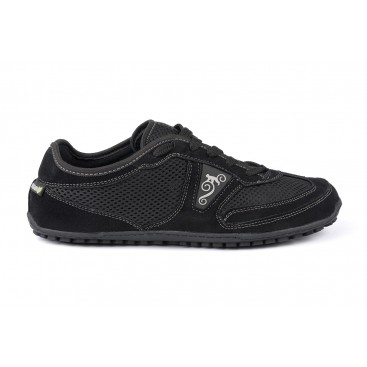
  • Running minimalist gives you better contact with the ground, increasing the pleasure of running and making you feel more “rooted” on the trail. For example, running in the Explorer model gives you only 5 millimeters of “magic” rubber underfoot!
  • And finally—perhaps not obvious, but true—minimalist running can save you significantly on running shoes, as you no longer need to worry about replacing your shoes because the cushioning has worn out. Minimalist shoes have nothing to "wear out."

MINIMALIST RUNNING – WHAT SHOES?

OK, I understand that there’s no point arguing with the above. Running naturally (minimalistically) is simply worth it. And if it’s worth it, it’s also worth having the right shoes for it. Running minimalist in traditional running shoes with a stiff sole and a high drop between the heel and toes is very difficult and sometimes impossible. Therefore, proper natural running shoes should meet several basic conditions:

  • Be flexible, both lengthwise and crosswise, and at the heel.
  • Have space for your toes.
  • Have no drop.

How do you quickly check this in practice during a visit to the store? You can read about this here [link to another article], where I demonstrated, using examples of minimalistic shoes from Magical Shoes, how to perform three basic tests for minimalism.

MINIMALIST RUNNING – START WISELY!

Got the belief, got the shoes—ready to hit the trail and conquer the world? Not so fast! Most of us need to start by reminding our legs what they’re supposed to do when running naturally. Of course, there are people who haven’t run at all yet or have been using a natural technique since birth, but these are exceptions among us.

The most common path to minimalist running leads through the popular “classic” running technique, landing on the heel and relying on the shoe’s cushioning—until it stops working. Then, due to pain, frustration with injuries, or the cost of new shoe models, runners begin to experiment with changing their running style.

Changing your running technique—like most significant changes—requires time and attention to bring benefits rather than harm.

  • First: Your foot muscles will start working. Soreness and cramps in your feet? Yes, it’s possible!
  • Second: You will significantly strain your Achilles tendons (they will start to stretch).
  • Third: Your calves will burn, harden, and increase in size.

This is why you need two things: a transition period and adaptive exercises.

MINIMALIST RUNNING – TRANSITION PERIOD

The transition period is primarily an exercise and a challenge for your mind and psyche. Interestingly, the more you have run before, the greater the challenge. Because... regardless of whether you ran 30, 50, or 100 kilometers a week, you're starting from zero. The past doesn't matter—your legs must learn to run again (and so must other parts of your body). You start as if it were your first-ever training sessions and gradually increase the distance.

According to the accounts of people who have changed their running technique, the entire process usually takes 2 to 6 months. That’s why it's best to do it after the racing season, when there’s some room to ease off. For the author of this guide, it took four months—from the last marathon in very stiff shoes to the first half-marathon in extremely minimalist footwear.

Therefore, it’s worth emphasizing again: regardless of your running history, here you are a beginner. And as beginners, you must learn to master the new technique and give yourself time to strengthen your propulsion system.

Of course, you can help yourself with this—by walking barefoot as much as possible (at least at home, but you can do it in your neighborhood too) or picking up objects from the ground with your feet instead of your hands. Overall, the idea is to relearn that you have feet and give them the opportunity to work and strengthen.

MINIMALIST RUNNING – ADAPTING YOUR BODY AND TECHNIQUE

The biggest change in how you run will be the automatic shortening of your stride length during a run, which—if you want to maintain the same pace—will result in an increased cadence (number of steps per minute). Why this change? Well, running minimalist and without a drop makes it very difficult to "unnaturally" land on your heel (without cushioning, that really starts to hurt). As a result, your foot "wants" to land in the most natural way for it, which is to touch the ground with its midsection (specifically, the outer edge of the midsection near the "pad" before the toes). To allow this, you must place your foot roughly under your body's center of gravity, meaning "beneath you" rather than "in front of you." It looks something like this:

While running, remember to keep your arms moving along your body (not across it) and maintain a straight posture with a slight forward lean, which helps you gain speed (the first posture illustrates this well).

For your first runs, whether in minimalist shoes or barefoot, it’s best to avoid grass or sand and instead run on... asphalt. This way, you can clearly feel how you are placing your feet and get feedback (discomfort) if something is off. In the beginning, don't overdo the distance—1 kilometer is enough to feel the "new" in your legs.

For those thinking, "I’ll run 1 kilometer in minimalist shoes and then 15 in my old ones"—mixing techniques like this weakens adaptation and overall prolongs the transition to natural running. So, I advise against it. It's either one way or the other.

Because you’re not striking the ground with your heel, the impact forces are distributed differently upon landing. What would otherwise go into the cushioning and then hit the knee joint is now absorbed and stored by the small muscles of the foot’s sole, then the plantar fascia (which requires great care), and finally the soleus muscle in the calf. Your knees benefit from this, but your feet and calves... well, they need strengthening to avoid overloading muscles and overstretching tendons that have lost elasticity over years of walking and running in traditional shoes.

Exercises to strengthen them include:

  • Walking barefoot (as much as possible).
  • Standing on your toes—working the calves. Start with both feet, and over time progress to standing on one foot. You can place something under your toes to increase the range.

Minimalist Shoes – Strengthening Feet and Calves

  • Rolling a ball under the foot – strengthens the foot and massages the plantar fascia.
  • Towel grabbing with toes – strengthens the foot and fascia (plantar aponeurosis).
  • Single-leg squats – strengthens the entire leg, ankle, and improves balance.
  • Stretching the fascia by holding the base of the toes with the opposite hand and bending the toes backward.
  • Stretching the calf muscles by standing with the entire foot on the ground, at arm’s length from a wall, and gradually pulling the hips closer to the wall (keeping the knee of the back leg straight). If you don't feel a stretch in your calf, you can place something under the toes of the back foot to force a deeper stretch of the muscle.

Minimalist Running – Transition Period Risks

The two main risks are doing too much, too soon, and losing motivation due to the duration of the process. While the outcome of the latter is obvious—abandoning the change and returning to cushioned running shoes—the risk of overtraining is often underestimated, which is a big mistake. Overloading the plantar fascia can lead to a very painful and hard-to-heal inflammation, while straining the calf muscles can even result in tendon tears.

Therefore, during the transition period, it is crucial to focus on:

  • Recovery.
  • Strengthening the elasticity of tendons.
  • Building the strength of foot and calf muscles.
  • Gradually increasing distances.
  • Avoiding the addition of challenging training elements—such as hill running—that place significant stretching forces on the Achilles tendon and plantar fascia.

Still, it’s worth trying. A carefully and thoughtfully managed change in running technique is something that will benefit you for the rest of your running career. Spending a few months learning is a small price to pay for years of reaping the rewards of natural running and minimalism. You’ll see for yourself :-)

Author: Jakub Abramczuk
Runner, ultramarathoner, Running Journalist of the Year 2016, professional internet wizard ;)
Kuba’s Blog: https://100hrmax.pl/
Running Shoes

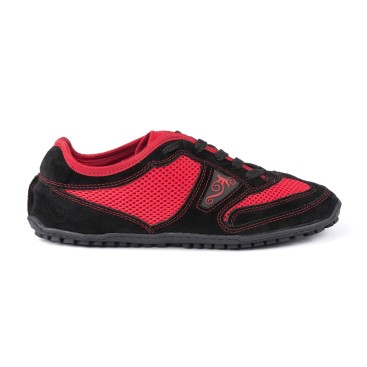
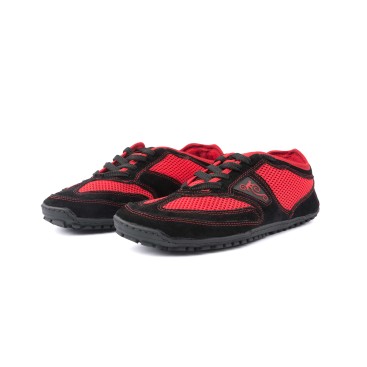
Check out the models perfect for your first adventures in natural running.